Refrigerator Repair
Is an Extended Warranty Worth It on a Luxury Appliance? Two Numbers Decide
On a built-in refrigerator an extended plan earns its price only when it covers sealed-system labour and pays a rate a working technician will accept. Here is how to test a plan against the repairs a built-in actually needs.
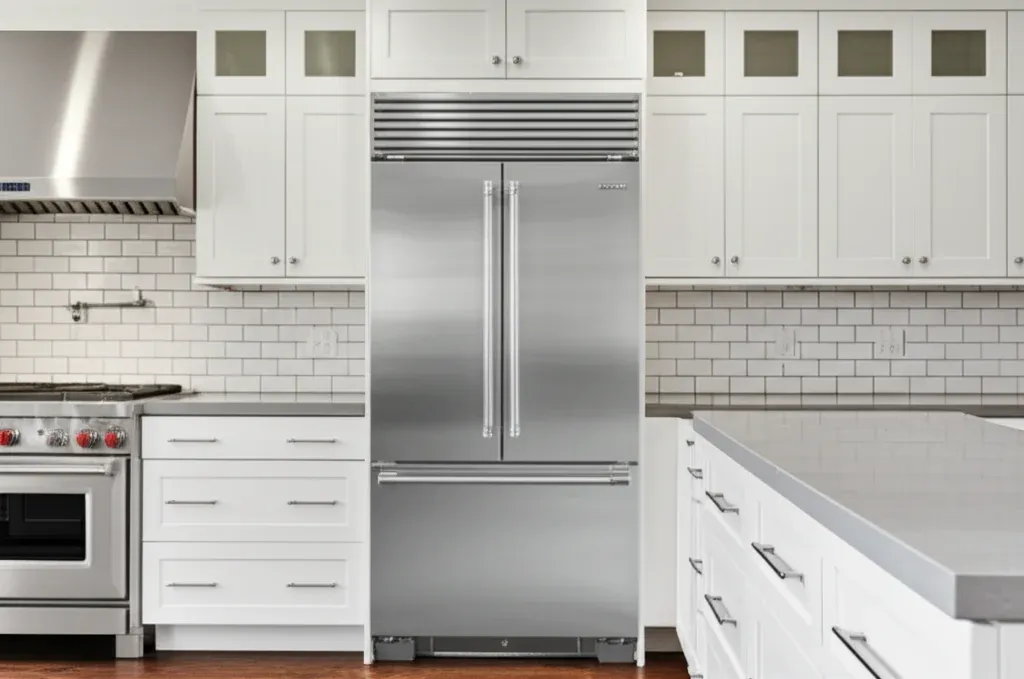
An extended plan on a built-in refrigerator is worth buying when it covers sealed-system labour, names the labour rate it pays, and does not settle in depreciated value. Plans that meet all three are worth the money on an integrated column. Plans that miss any one of them are usually worth less than the same money left in an account, because the repair they exclude is the only repair large enough to have justified the purchase.
That is the whole answer. The reasoning is arithmetic, and it is worth doing on paper before the finance desk closes.
The two numbers
The first number is what the plan costs across its full term, including any per-visit deductible. Not the monthly figure — the total, because that is what you are wagering.
The second is the distribution of repairs a built-in actually needs. Most of what goes wrong on a cabinet of this kind lands in a familiar range: a door gasket runs $280 to $770, an evaporator or condenser fan motor $320 to $650, a defrost heater, thermostat or sensor $290 to $710, an ice maker, water valve or supply line $280 to $650. Controls sit above that, at $520 to $870 for an electronic board. Then there is one repair in its own bracket — compressor and sealed-system work, $980 to $2,130.
Set those side by side and the shape of the decision appears. If a plan’s total cost is close to the middle of that first group, it is insuring you against events you could absorb, and excluding the one you could not. Insurance is only rational at the top of the distribution. A plan that covers gaskets and fan motors but writes sealed-system labour out of the contract has sold you cover for the events you were never worried about.
Why the sealed system is the whole test
The sealed system is the compressor, the condenser, the evaporator and the refrigerant circuit joining them — the closed loop that does the actual cooling. It is welded, charged and sealed at the factory, and opening it is a different order of work from anything else on the appliance: recovery, brazing, evacuation and a measured recharge, done on site, in a kitchen, with the cabinet in place.
Two things follow. It is the most expensive thing that can fail, and it is the failure most likely to arrive after the manufacturer’s own term has run out. That combination is the definition of a risk worth transferring to somebody else.
So the first question for any plan is not what it costs. It is whether sealed-system labour is covered, in those words. Parts-only cover on this repair is nearly worthless: the parts are a small fraction of what the day costs. Find the sentence, and if it is not there, treat the plan as a plan for the small stuff.
What the claim looks like on the day
A contract reads like cover. A claim behaves like a process, and it is the process that decides whether the cover was real.
The technician arrives, diagnoses, then telephones for authorisation before touching anything. That call is where the terms turn into money. Three things get decided on it: whether the fault is a covered category, what labour rate the plan pays, and where the part is coming from.
The labour rate matters more than most buyers expect. A plan that pays well below the going rate for built-in refrigeration is a plan whose approved list will be short and whose visit dates will be distant, because experienced independent shops decline the work. You are not buying cover so much as buying access to whoever accepted that rate.
The part matters on any appliance more than a decade old. Plans handle a discontinued module in one of two ways: they source a used or refurbished equivalent, or they invoke a replacement clause. Ask which, and ask it before signing rather than while standing in front of a warm cabinet.
The replacement clause, read properly
“We will replace rather than repair” sounds like the strongest sentence in the contract. On an integrated appliance it is frequently the weakest.
The reason is that a built-in refrigerator is not an appliance sitting in a gap. It is a piece of cabinetry with a compressor in it. A Classic built-in in the 36 to 42-inch range runs $11,600 to $16,800 for the appliance by itself, and the panels and cabinetry work that make it fit add somewhere around $2,000 to $5,000 again. A settlement calculated on the depreciated value of a fifteen-year-old unit does not approach that, and it does not pretend to. The gap is yours.
If the clause is there, find out what it settles on: a like-for-like replacement, the current retail price of an equivalent, or depreciated value. Those are three quite different products wearing one sentence.
Four questions, and then decide
Ask these of the plan document rather than of the person selling it, because the answers are in writing or they are not answers.
- Is sealed-system labour covered, and is there a per-claim or annual cap that sits below $2,130?
- What is paid if the part is no longer manufactured — a used part, a refurbished one, or a settlement?
- Does a settlement pay replacement cost or depreciated value, and does it include panels and installation?
- Can I use my own technician, and if not, what rate does the plan pay the ones it sends?
A plan that answers all four cleanly on an integrated column is a reasonable purchase. A plan that answers none of them is a subscription.
Self-insuring, in practice
The alternative is not “do nothing”. It is to put the money the plan would have cost into an account you do not touch, and to spend some of it early on the two things that reduce the odds: keeping the condenser clean and dealing with small faults while they are still small. A door seal that no longer pulls closed is a $280 to $770 job that also makes the compressor run longer than it should. Left for two years it is still a gasket, and the compressor has done two years of unnecessary work.
That is the case for self-insuring in one line: the fund pays for the failure and for the maintenance, and the plan only ever pays for the failure.
Where to start today
Find the purchase date and the original paperwork before deciding anything, because the sealed-system term written there is usually longer than the whole-unit term and it may already cover you. If the cabinet is out of term and currently faulty, the useful move is to get a real diagnosis and a real figure to compare against whatever a plan would have paid: the visit and full diagnosis is a flat $95 here, credited against the repair once you approve it. A number beats an estimate when you are deciding whether cover was ever worth buying.
Call, or use the booking page, and have the model and serial from inside the cabinet to hand.
Also asked
I bought a plan from a third party years after the appliance. Is it the same thing?
Rarely. Plans sold mid-life almost always carry a waiting period before anything can be claimed, and an exclusion for conditions that existed before the start date. A refrigerator that has been running a degree or two warm for a season can be argued into that exclusion by an adjuster who has your service history in front of him. Read the effective date and the pre-existing clause together, because they only make sense as a pair.
My home warranty policy says it covers appliances. Does that change the answer?
It changes what you are comparing. A home policy usually pays up to a cap per appliance for the year, and on a built-in that cap is often below the cost of the repair it would be called on for. The policy also chooses who attends. Neither is a reason to drop it — it covers a boiler and a water heater too — but it is not equivalent cover for a panelled column and should not be counted as if it were.
There is an active plan on the machine. Should I still ring an independent shop?
Use the plan first. That is what it was bought for, and work arranged outside the plan is the one thing every contract of this type excludes. Ring us afterwards if the plan declines the claim, caps the payout below the repair, or leaves the appliance waiting on a part with no date attached — at that point you are paying for the repair anyway and you may as well know what it really costs.